

The Direction Problem: Where Does Movement Come From?
Where does the direction come from?

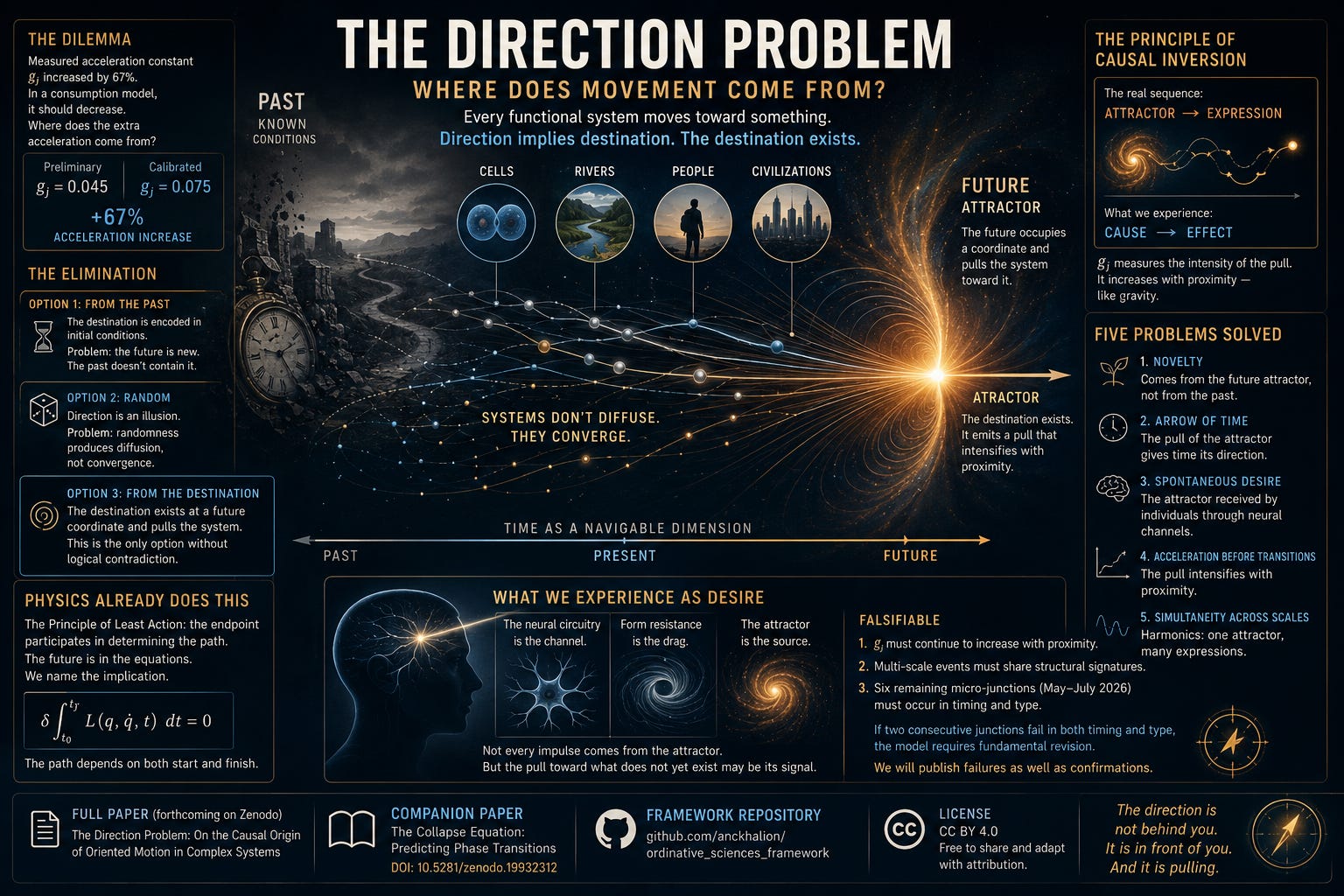
Every living thing moves toward something. A cell divides toward the next cell. A river flows toward the sea. A person wakes up with a desire that wasn’t there yesterday and begins to move toward something that doesn’t yet exist.
Where does the direction come from?
This is not a philosophical question. It is the most concrete question in science — and it does not have a satisfactory answer in the conventional framework. This paper offers one.
The Dilemma That Started It
We were building a mathematical model to predict phase transitions in complex systems (published as The Collapse Equation). The model worked — it predicted two events in both timing and structural type before they occurred. But in the process of calibrating the model, we encountered something that shouldn’t happen.
We measured an acceleration constant — call it g_j — that tells you how fast a system approaches its next transition point. The preliminary value was 0.045. After two confirmed events gave us direct calibration, the new value was 0.075.
A 67% increase.
Here is the problem: in the model’s original reading, g_j measures how fast the system consumes its internal capacity. A system consuming its resources should slow down, not speed up. A car running out of fuel decelerates. It does not gain speed.
Where was the extra acceleration coming from?
The Observation
Set aside the specific model. Consider the most general observation you can make.
Every functional system — every thing that does something — has a direction. It moves toward something. Not randomly: toward something.
A cell doesn’t divide in a random direction. An organism doesn’t grow into a random shape. A river doesn’t flow uphill. Even a civilization, for all its chaos, moves toward its next form — not randomly, but with a direction that becomes visible in retrospect and, as we’ve shown, measurable in advance.
This property is everywhere. It is scale-invariant — it appears at every level of observation, from molecules to civilizations. And it has a logical consequence that is inescapable:
Direction implies destination.
A vector points toward something. If there is nothing to point toward, there is no direction. If there is no direction, there is no systematic motion — only diffusion. But systems don’t diffuse. They converge.
So: the destination exists.
The Elimination
Where is the destination?
Option 1: It comes from the past. The system’s initial conditions plus physical laws determine where it goes. The destination is already “encoded” in the starting point.
Problem: if the past contains the destination, then the destination is not new. But the destinations of functional systems are typically new — configurations that did not exist before. A caterpillar does not contain a butterfly. The initial conditions of a civilization do not contain its successor form. Science calls this “emergence” — but the word names the mystery without solving it.
Option 2: It’s random. There is no destination. What we see as “direction” is a statistical illusion.
Problem: random motion is diffusion — it produces dispersion, not convergence. Our measured g_j is not a diffusion coefficient. It is an acceleration constant. And it is increasing. Randomness does not accelerate toward anything.
Option 3: It comes from the destination itself. The destination exists at a future coordinate and pulls the system toward it, the way gravity pulls a falling body toward the earth.
This option has no logical contradiction. And it is the only one left.
The Objection — And Why It Doesn’t Hold
The immediate objection: “You’re saying the future already exists? That’s predestination.”
No. The attractor determines the direction, not the path. Every system moving toward the same attractor can take a different route, depending on its own internal state. A hundred rivers flow toward the sea. Each takes a different path. The sea doesn’t choose the path — it provides the pull.
And there is a precedent — a 250-year-old one.
The Principle of Least Action: Physics Already Does This
The most foundational principle in all of physics is the Principle of Least Action (Maupertuis, 1744; Lagrange, 1788; Hamilton, 1834). It says: a system evolves along the trajectory that minimizes the “action” over the entire path from start to finish.
To compute the trajectory at any intermediate point, you need to know where the system ends up. The endpoint participates in determining the path.
Physicists have used this for over 250 years without calling it what it is: structurally teleological. The future participates in determining the present. They just express it as differential equations and don’t name the implication.
We name it.
The Principle of Causal Inversion
Every determined result occupies a coordinate in a space where time is a navigable dimension — just as space is. From that coordinate, it emits a signal — a pull — that intensifies with proximity.
What we observe as the sequence “cause → effect” (past pushes present) is the projection of the real sequence: “attractor → expression” (future pulls present).
The acceleration constant g_j measures the intensity of this pull. It increases as you approach the attractor — exactly as gravitational acceleration increases as you approach a massive body. The 67% increase we measured is not anomalous. It is the direct signature of the pull intensifying.
Five Problems Solved
Once you accept this as a working hypothesis, five open problems in science resolve simultaneously:
1. Where does novelty come from? Not from the past (which doesn’t contain it). From the attractor — the future configuration that doesn’t yet exist in the present but is pulling the system toward it.
2. Why does time have a direction? The fundamental equations of physics are time-symmetric. The “arrow of time” is not in the laws. It is in the pull of the attractor: systems move toward the future because the attractor is there.
3. Where do spontaneous desires come from? Neuroscience describes the mechanism (dopamine, reward circuits) but not the origin. Why this desire? Why now? The pull of the attractor, received by an individual at their own scale. The neural circuitry is the channel. The source is the attractor.
4. Why do systems accelerate before transitions? The conventional explanation (positive feedback loops) is circular. The real answer: the attractor pull intensifies with proximity, like gravity.
5. Why do unrelated events at different scales happen simultaneously with the same structural signature? Not correlation. Not contagion. Harmonics: every scale receives the same attractor signal and responds with its own expression. Like piano strings resonating from a tuning fork — not because they communicate, but because the source is one.
What We Experience as Desire
Here is where the principle becomes personal.
What you experience as desire — the pull toward something that does not yet exist — may be the individual-scale expression of the same structure that g_j measures at civilizational scale.
The neural circuitry is the channel. The form resistance of your current identity is the drag. The source is the attractor — the future configuration that is pulling you.
Not every impulse comes from the attractor. Reactions to stimuli are push dynamics — something in the environment triggers a response. But the impulses that arise without external trigger — creative desire, unexplained attraction, the pull toward something you cannot yet name — those may be the signal of the attractor, received at your scale, modulated by your state.
The note is different for each person. The frequency is the same.
Falsifiable
This is not mysticism. The principle makes specific predictions:
g_j must continue to increase with proximity to the attractor. If it doesn’t, the principle fails.
Multi-scale events must share structural signatures. If they don’t, the harmonic model fails.
Six remaining micro-junctions are predicted between May and July 2026, each with a date and a type. If two consecutive junctions fail in both timing and type, the model requires fundamental revision.
We commit to publishing failures as well as confirmations.
Full paper: The Direction Problem: On the Causal Origin of Oriented Motion in Complex Systems (forthcoming on Zenodo)
Companion paper: The Collapse Equation: Predicting Phase Transitions — DOI: 10.5281/zenodo.19932312
Framework repository: github.com/anckhalion/ordinative_sciences_framework
License: CC BY 4.0
The direction is not behind you. It is in front of you. And it is pulling.